
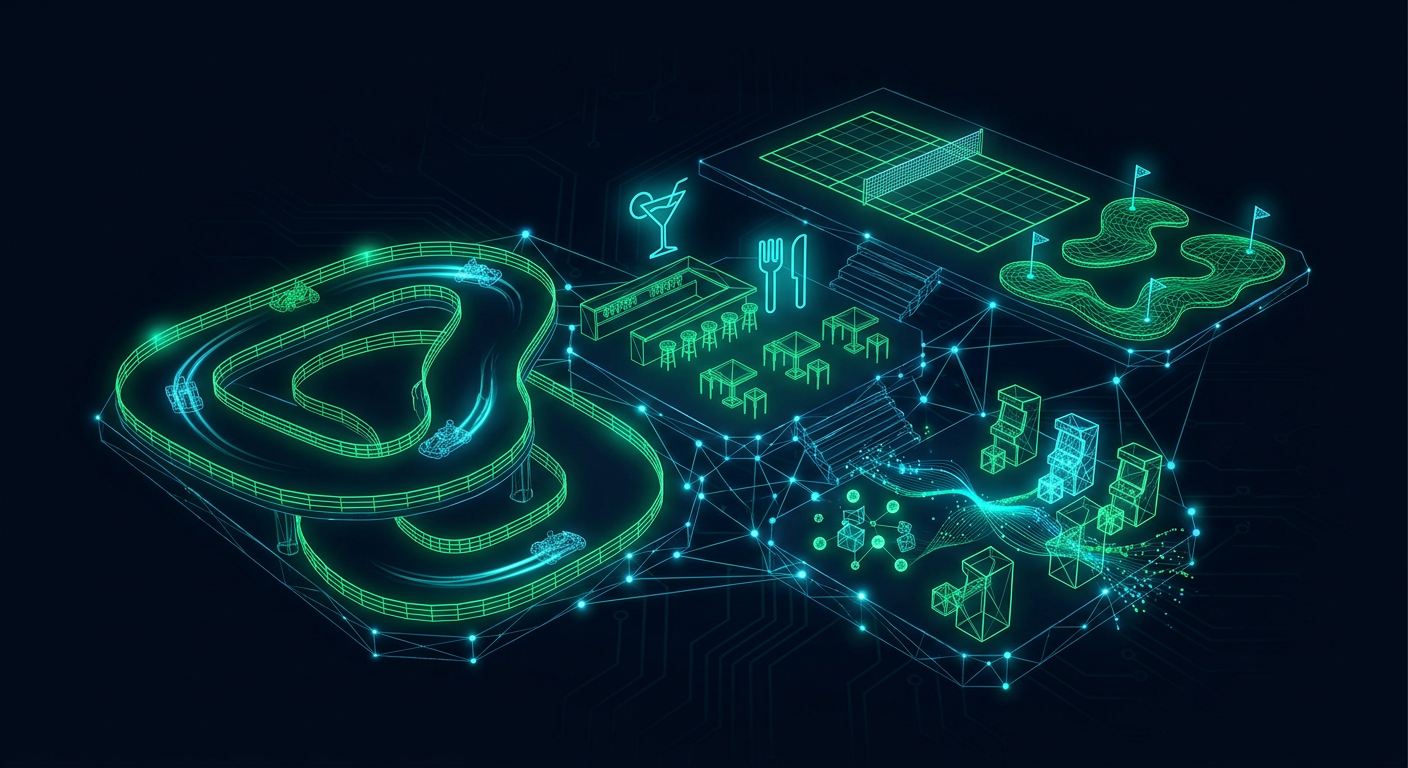
A guest walks into your standalone driving range on a Saturday afternoon. They hit a bucket of balls - maybe two. Forty-five minutes later, they’re back in their car. You earned $25.
Down the road, a competitor offers a driving range plus mini-golf, a simulator lounge, an arcade, and a full-service bar. Their guest arrives at the same time but doesn’t leave for three hours. They spend $85.
Same Saturday. Same market. Wildly different revenue per visit. The difference isn’t luck or location - it’s dwell time, and it’s quietly reshaping the entire entertainment venue industry.
The Math Behind the Stay
The relationship between how long a guest stays and how much they spend isn’t complicated: more time equals more money. But the magnitude of the effect catches most operators off guard.
According to industry data compiled from IAAPA and IALEI research, the average family entertainment center visit lasts about 2.3 hours, with per-capita spending ranging from $11 to $24 per paying guest 1. That’s for a typical FEC with multiple attractions. Compare that with a standalone bowling alley or single-attraction arcade where the average visit might last 45 to 60 minutes, and the spending gap becomes stark.
The data tells a clear story: multi-attraction venues generate two to three times the revenue of standalone bowling alleys operating in similar markets 2. That multiplier isn’t just about charging for more activities - it’s about what happens when guests stick around. They get hungry. They get thirsty. They decide to try “just one more thing.” Each additional 30 minutes in your venue is another opportunity for incremental spend.
When VR attractions were added to FECs that previously lacked them, dwell time increased by 25% 3. That’s not a small bump - it’s the difference between a guest leaving before lunch and staying through it.
The Topgolf Blueprint
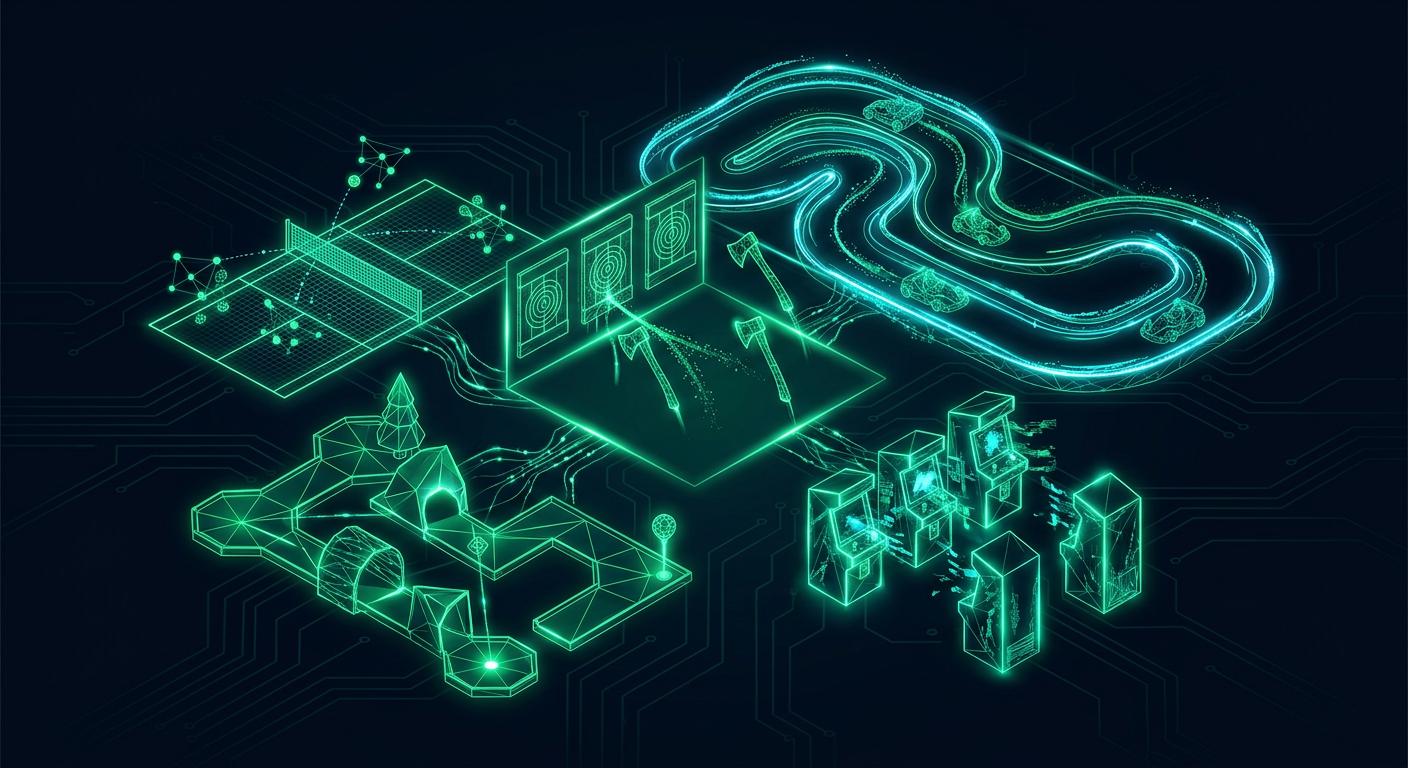
No company has demonstrated the power of multi-experience design better than Topgolf. What started as a technology-enhanced driving range evolved into something fundamentally different: a social entertainment destination where golf is almost beside the point.
The numbers tell the story. The average Topgolf customer spends approximately two hours per visit 4, with walk-in spend averaging around $38 per person 5. But here’s the detail that should make every standalone driving range owner sit up: only one-third of Topgolf’s venue revenue comes from gameplay. The remaining two-thirds flows from food and beverage, corporate events, and ancillary spending 6.
Think about that. Topgolf built what looks like a driving range but operates like a restaurant-entertainment hybrid where F&B accounts for roughly half of total revenue 7. A traditional driving range gets nearly 100% of its revenue from range fees. Topgolf extracts three to four times the revenue per visit from the same fundamental activity - hitting golf balls - by layering food, drinks, games, music, and social experiences around it.
Each Topgolf location attracts an estimated 250,000 or more visitors annually 8. At $38 per head, that’s nearly $10 million per location per year - from a “driving range.” The model has attracted 60% of visitors aged 18–54 and 40% female guests 5, demographics that traditional ranges struggle to capture at all.
From Bowling Alleys to Entertainment Centers
The bowling industry is living through this transition in real time. The old model - 32 lanes, a snack bar, and a pro shop - is being replaced by something far more ambitious. And the operators making the switch are seeing dramatic results.
Bowlero, now operating over 350 locations across the United States, has built its entire strategy around transforming traditional bowling alleys into multi-attraction entertainment centers. The company posted $337.7 million in quarterly revenue in early 2024, with total location revenue growing 17.5% year-over-year 9. Bowlero’s model layers arcades, laser tag, event spaces, and elevated food and beverage around a bowling core - and the results speak for themselves.
Dave & Buster’s and its sister brand Main Event Entertainment together operate 200 locations generating a combined $1.9 billion in annual revenue with 13% same-store sales growth 10. Main Event’s venues feature bowling, arcade games, laser tag, mini-golf, VR, gravity ropes, and full-service dining - a deliberate strategy to ensure no guest runs out of things to do (or spend money on).
Industry consultant Frank the Crank documented a telling case: a bowling center that converted 6,000 square feet of underutilized space into a laser tag arena generated an estimated $250,000 in new laser tag revenue alone, while total facility gross revenue - including increased F&B, birthday party bookings, corporate events, and even bowling revenue itself - jumped by $500,000 to $750,000 11.
That last detail matters. Adding attractions doesn’t just generate revenue from the new activity - it lifts spending across the entire venue.
The Canadian and North American Outlook
The numbers aren’t just an American story. Canada’s indoor amusement center market, which includes bowling alleys and FECs, is forecasted to grow from $2.97 billion in 2024 to over $5 billion by 2030 - a compound annual growth rate of 9.5% 12. That growth is being driven overwhelmingly by multipurpose venues that combine traditional attractions with modern entertainment experiences.
The U.S. bowling market, by comparison, is projected to reach $1.4 billion by 2033 at a more modest 4.6% CAGR 12. The gap between these growth rates tells you exactly where the industry momentum lies: operators who diversify are growing more than twice as fast as those who don’t.
The Australia and New Zealand Model
In the Asia-Pacific market, TEEG (The Entertainment and Education Group) has become the dominant example of multi-attraction diversification done at scale. Operating over 300 venues across Australia, New Zealand, and Southeast Asia under the Timezone, Kingpin, and Zone Bowling brands 13, TEEG’s strategy has been explicitly built around combining entertainment formats.
Kingpin venues layer bowling with laser tag (laser skirmish), escape rooms, karaoke, arcades, and full bars - positioning each location as a multi-hour social destination rather than a single-activity stop. In 2019, TEEG began rolling out dual-branded Timezone and Zone Bowling venues 14, physically combining arcade and bowling under one roof to maximize cross-selling and dwell time. The company planned to open 50 additional outlets in a single year 13, a pace of expansion that signals strong unit economics from the combined model.
For operators across Australia and New Zealand, the TEEG model proves that the multi-attraction approach works across different market sizes, from major metro centres to regional locations.
The “One More Thing” Psychology
There’s a behavioral principle at work here that goes beyond square footage and attraction counts. Behavioral economists call it the “sunk cost” effect combined with “decision momentum” - once a guest has committed to visiting your venue, every subsequent purchase faces dramatically lower friction than the initial one.
Your guest has already driven there, parked, walked in, and paid for one activity. The psychological barrier to trying a second activity is a fraction of what it took to get them through the door in the first place. A $12 round of laser tag after bowling feels like an impulse buy. That same $12 as a standalone trip? Most people wouldn’t bother.
This is why multi-attraction venues consistently see higher F&B attachment rates. A guest who bowls for an hour and then plays laser tag for 30 minutes is now 90 minutes into their visit. They’re hungry. They’re comfortable. The bar is right there. Industry data shows that per-capita food and beverage spending can reach 30–40% of total FEC revenue 15, and guests engaged in multiple activities over longer visits are the primary driver of that number.
Topgolf’s experience validates this perfectly - guests who come “just to hit balls” end up ordering appetizers, drinks, and dessert because they’re having a good time and they’re in no hurry to leave.

The FEC Boom Is Not Slowing Down
The global family entertainment center market was valued at $34.4 billion in 2025 and is projected to reach $93.5 billion by 2035, reflecting a 10.5% CAGR 16. In the United States alone, the FEC industry generated approximately $8.2 billion in revenue in 2023, up 12% from the prior year 3. Attendance reached 450 million visits - an 18% increase 3.
These aren’t niche numbers. This is a massive, accelerating industry shift toward multi-attraction, experience-layered entertainment. Equipment manufacturers are reporting that 2024 was their best year ever for new orders, and 2025 is continuing the trend 17. The money is flowing toward venues that offer more, not less.
Meanwhile, 68% of FECs surveyed plan to add experiential dining concepts 3, recognizing that food and beverage isn’t just a nice-to-have - it’s a core revenue engine that only works when guests stay long enough to eat.
What This Means for Your Venue
If you’re operating a single-attraction venue - a standalone driving range, a bowling-only center, a traditional arcade - you’re not just competing with similar venues anymore. You’re competing with the multi-attraction center down the road that’s capturing three-hour visits while you’re capturing 45-minute ones.
Here’s the actionable framework for thinking about diversification:
Start With What Extends the Visit
Don’t add attractions randomly. Ask: what would make my current guests stay an additional 30–60 minutes? For a bowling alley, that might be an arcade zone and improved F&B. For a driving range, it might be mini-golf, a simulator bay, and a proper bar. The goal is complementary experiences that flow naturally from what you already offer.
Prioritize F&B as a Revenue Center, Not an Afterthought
Every additional minute of dwell time is a minute your guest might spend on food or drinks. Venues where F&B contributes 30–40% of revenue aren’t getting there by accident - they’re designing the guest journey to naturally include a meal or drinks. If your food program is still a snack counter with nachos and hot dogs, you’re leaving significant revenue on the table.
Bundle and Package Relentlessly
Multi-attraction venues thrive on combo packages - bowl + laser tag + pizza for one price, or a “play all day” pass that encourages guests to try everything. Bundling increases perceived value, drives trial of new attractions, and locks in higher per-visit revenue. Birthday party and corporate event packages that span multiple activities are particularly high-margin.
Invest in the Operational Backbone
Here’s where many expansion plans stumble: managing multiple attractions under one roof requires unified systems. Separate POS systems for bowling and arcade, different reservation platforms for different activities, paper waivers that don’t talk to your membership database - operational fragmentation kills the guest experience and buries your staff.
This is where a platform like EagleEye becomes essential. When you’re running bowling lanes, an arcade, laser tag, F&B, and event spaces, you need unified point-of-sale, integrated reservations across all attractions, digital waivers that connect to guest profiles, and membership programs that work everywhere in the building. Trying to stitch together five different systems for five different attractions is a recipe for operational chaos and lost revenue from booking friction.
Think in Terms of Revenue per Square Foot per Hour
Single-attraction venues often have dead space during off-peak hours. Multi-attraction venues can stagger demand - bowling peaks on weekend evenings, arcades draw afternoon foot traffic, laser tag fills birthday party slots on Saturday mornings, and the bar carries weeknight revenue. Diversification isn’t just about peak revenue - it’s about utilization across the entire week.
The Bottom Line
The entertainment venue industry is undergoing a fundamental structural shift. Single-attraction venues aren’t just growing slower than their multi-attraction competitors - in many markets, they’re actively losing ground. The data is clear: longer visits drive higher per-capita spend, multiple attractions create natural upsell pathways, and F&B revenue scales directly with dwell time.
The venues winning in 2026 and beyond aren’t the ones with the best single attraction. They’re the ones that have mastered the art of giving guests a reason to stay for one more hour and spend on one more thing.
The question for every venue operator isn’t whether to diversify. It’s how quickly you can start.
References
- What Is A Family Entertainment Center? - Adventure Solutions ↩
- Is a Bowling Alley Profitable in 2026? Investment & ROI Guide - OpenPR ↩
- Family Entertainment Centers Statistics: Market Data Report 2026 - Gitnux ↩ ↩2 ↩3 ↩4
- How Does Topgolf Stay on Target? - Sports Business Journal ↩
- Topgolf Primed For Growth - SGB Media ↩ ↩2
- Inside The Rise and Fall of Topgolf - Huddle Up ↩
- Topgolf Franchise in 2024: Costs, Fee & FDD - VettedBiz ↩
- Topgolf: The Complicated World of Economic Impact Analysis - Rochester Beacon ↩
- Bowlero Grows Revenues in Q1 Results - InterGame ↩
- Dave & Buster’s, Main Event Seek Top Billing in Family Entertainment Industry - FSR Magazine ↩
- Bowling Centers Also Being a Family Entertainment Center - Frank the Crank ↩
- Boost Bowling Alley Revenue With Arcade Games - Player One Amusement Group ↩ ↩2
- Timezone, Kingpin Owner TEEG Opens 300th Venue - Real Estate Source ↩ ↩2
- Zone Bowling - Wikipedia ↩
- The Family Entertainment Center Industry: Market Insights and Innovations - Arcade Integrations ↩
- Family Entertainment Center (FEC) Market - Future Market Insights ↩
- The State of the Global Attractions Industry in Q3 2025 - IAAPA ↩