

Most venues can tell you last Tuesday’s revenue to the penny. Almost none can tell you what their best customer ordered last month — or that she’s standing at the front desk right now.
There’s a moment that happens at entertainment venues thousands of times a day, and almost nobody notices it.
A family walks in on a Saturday afternoon. They’ve been here before — three times, actually. They spent $280 last visit on bay time, food, drinks, and arcade credits for the kids. They booked a birthday party here six months ago. They’re exactly the kind of guest every venue wants.
And the person at the front desk has no idea.
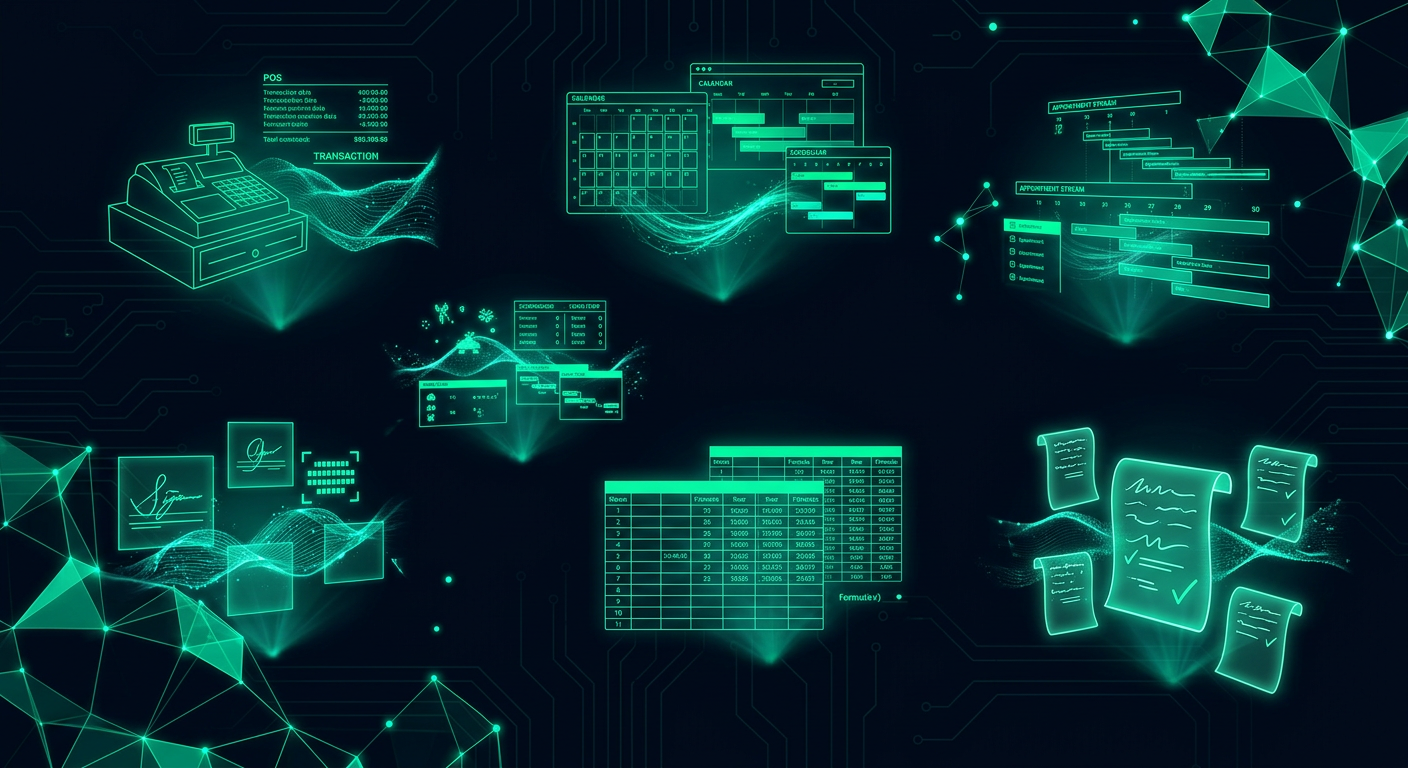
Not because the staff doesn’t care. Because the booking system doesn’t talk to the POS. The POS doesn’t talk to the arcade card system. The event platform lives on a completely different login. So as far as every system is concerned, this family is a stranger. Again.

This isn’t a technology problem in the way most people think about it. It’s not about having bad software. Most venues are running perfectly decent tools — Toast, Square, OpenTable, When I Work, SmartWaiver, maybe an Intercard setup for the arcade. Each one works fine on its own.
The problem is the space between them.
The Gaps You Can’t See on a Dashboard
When your systems don’t share data, you don’t get error messages. You get silence. And silence is expensive.
You can’t recognize repeat guests. A family that’s visited four times looks like four separate first-time visits across four separate systems. You can’t greet them by name. You can’t thank them for coming back. You can’t offer them the bay they always prefer or remember that Dad is allergic to shellfish.
You can’t understand full-visit spending. A guest who books a bay online, orders lunch from the QR menu, buys arcade credits at the counter, and picks up a gift card on the way out looks like four unrelated transactions. Their actual lifetime value is invisible to you — which means your marketing is guessing.
You can’t catch problems before they become reviews. If a bay reservation gets double-booked because the booking tool doesn’t see the walk-in the front desk just seated, staff scramble and the guest waits. That’s not a system failure anyone logs. It’s just a bad experience that shows up two days later as a three-star Google review.
You can’t do the basics of hospitality. Hospitality isn’t just good service in the moment — it’s remembering. It’s “Welcome back, the usual bay?” It’s knowing that the corporate group that comes every quarter likes high-tops near the bar. Fragmented systems make remembering impossible, no matter how good your team is.
 ---
---
What Venues Are Actually Running (And What It Actually Costs)
We talk to venue operators constantly, and the same pattern shows up over and over. A typical golf entertainment venue or FEC is running some combination of:
- A POS (Toast, Square, Aloha, or similar) handling food and beverage
- A booking/reservation tool (anything from a WordPress plugin to a purpose-built platform) managing bay or lane availability
- A separate system for arcade or game cards (Intercard, Embed, or similar) with its own backend
- A waiver platform (SmartWaiver or paper) that lives in its own database
- A scheduling tool (When I Work, Homebase, 7shifts) for labor
- Spreadsheets filling every gap the other five tools leave open
Each tool costs $50–$300/month. That’s $3,000–$15,000 a year in subscriptions alone. But the subscription cost isn’t the real expense.
The real expense is the integration tax: the staff hours spent reconciling data between systems, the double-entry when a booking needs to be manually added to the POS, the three hours every morning the GM spends checking six different dashboards to understand what happened yesterday.
We consistently hear operators describe spending 2–4 hours per day on manual data reconciliation. At a loaded labor cost of $30–$40/hour, that’s $20,000–$40,000 a year in invisible overhead — just to connect systems that should already be connected.
And that’s before you count the revenue you’re leaving on the table because you can’t cross-sell, can’t retarget, and can’t recognize the guest standing in front of you.
 ---
---
What Changes When the Guest Is Known
The shift isn’t dramatic from the outside. There’s no moment where fireworks go off. But the math changes immediately when every touchpoint feeds into one guest profile.
Check-in becomes recognition. A returning guest scans in at the kiosk and the system already knows their name, their membership tier, their last visit date, and that they usually book Bay 12. Staff can greet them personally without asking them to spell their last name again.
Spending becomes visible. One transaction record captures the full visit — the bay booking, the food, the drinks, the arcade credits, the retail purchase on the way out. You can now see that this guest averages $180 per visit, not the $45 the POS was showing for just the food.
Marketing becomes targeted. Instead of blasting your whole email list with a generic promo, you can reach the 200 families who visited in the last 90 days but haven’t been back, with an offer based on what they actually did last time. The difference in conversion rate isn’t marginal — it’s typically 3–5x.
Events become seamless. When the party booking, the F&B pre-order, the waiver, and the bay reservation all live in one system, a birthday party goes from a four-system coordination nightmare to a single workflow that staff can manage without a clipboard.
Staffing becomes data-driven. When your booking volume, POS traffic, and historical patterns are all in one place, you can forecast staffing needs instead of guessing. Overstaffing slow Tuesdays and understaffing packed Saturdays is a labor cost problem that good data solves immediately.
The Switching Question
The most common pushback we hear is: “We already invested in these tools. Switching everything at once sounds risky.”
It’s a fair concern. But here’s what operators tell us after they’ve done it:
The switch itself is usually smoother than expected. The bigger risk — the one that compounds daily — is staying on a fragmented stack where every guest is a stranger, every visit is a fresh transaction, and every insight requires manually stitching data from six different logins.
Most operators who consolidate describe the same realization: the old setup wasn’t cheaper. It was just spreading its cost across so many different line items — subscriptions, labor hours, missed revenue, poor guest retention — that the total was invisible.
The Simple Test
Here’s a quick gut check for any venue operator:
- Can you pull up a guest by name and see every visit, every transaction, every event they’ve attended, in one place?
- Can your front desk staff see that a walk-in is a VIP member before they say a word?
- Can you tell, right now, what your average guest’s full-visit spend is — not per-terminal, but total?
- When a guest books online, does that reservation automatically appear in your POS, your floor plan, and your staffing forecast?
If the answer to any of those is no, the gap between your systems is costing you more than you think. Not in a dramatic, venue-closing way — but in the slow, daily accumulation of missed recognition, missed upsells, and missed repeat visits that add up to real money over a year.
What This Looks Like in Practice
EagleEye was built specifically to close these gaps. One platform handles the POS, bookings, events, memberships, waivers, inventory, marketing, and analytics — with a single guest profile that tracks every interaction across every touchpoint.
No monthly subscription fees. No integration tax. And no more treating your best guests like strangers.
EagleEye is the operating system for experiential venues — golf entertainment, FECs, driving ranges, and multi-attraction destinations. One platform. One guest profile. Zero monthly fees. Learn more →